


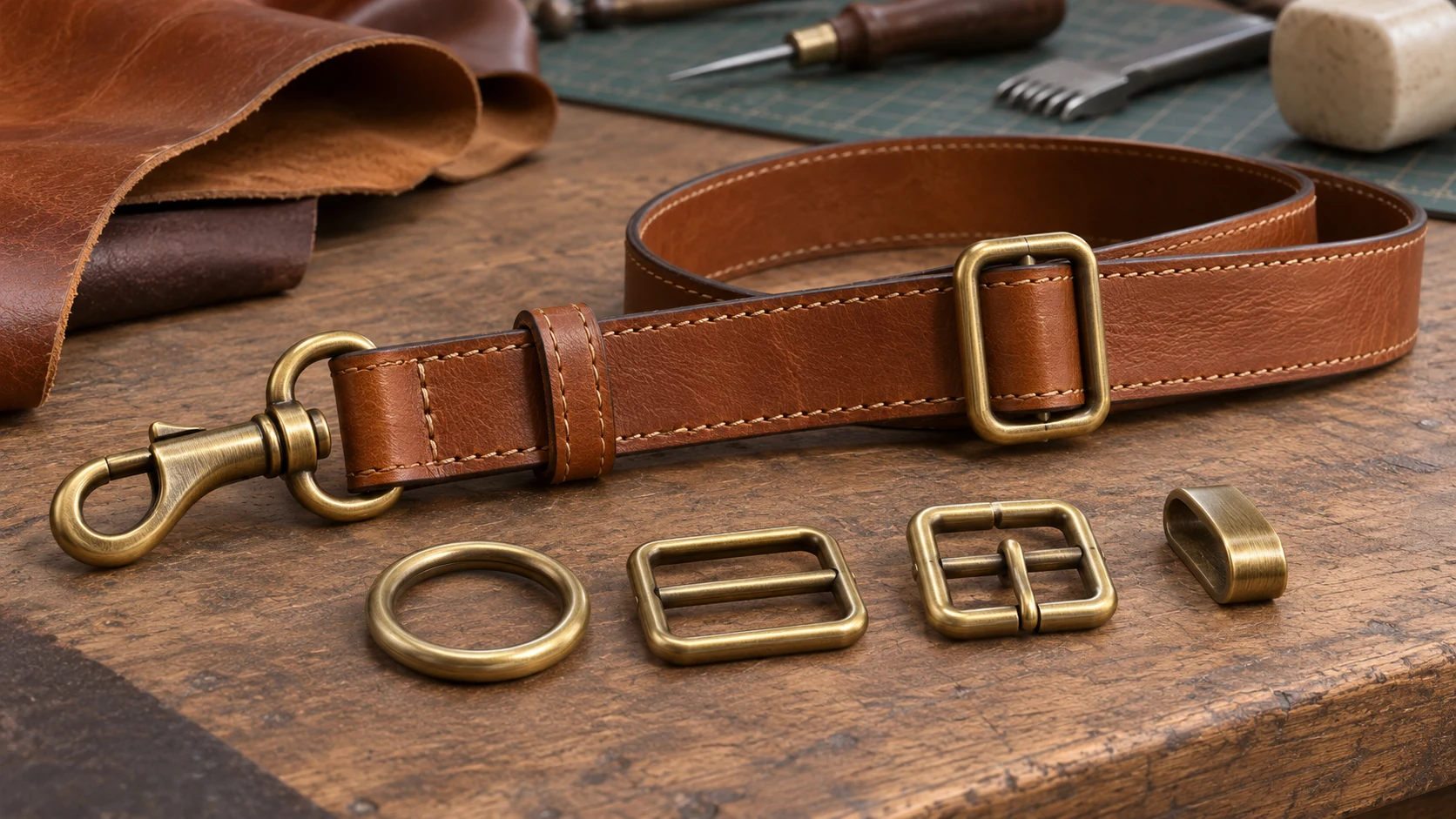
Bag Rings, Strap Keepers, Buckles and Snap Hooks: A Selection Guide
On a bag, shoulder strap or belt, hardware is not a finishing detail to select at the end. Rings, sliders, strap keepers, buckles and snap hooks determine the path of the strap, the way it is adjusted or removed, and the visual consistency of the whole piece. A well-considered combination supports the construction; a choice based only on shape or finish can create issues with proportions, strap movement and assembly.
The useful starting question is not “which accessory looks best?”, but what must this part of the bag do? It may connect a shoulder strap to the body, adjust its length, retain its loose end, allow removal, or simply complete the design. Each answer points to a different family of components and to different checks on a real sample.
This guide separates those functions and explains what to check before cutting the final material. The Italian catalogue category for rings and sliders is the commercial reference for this family; for the English article, internal category links are intentionally omitted until verified English equivalents are available.
Start by drawing the strap path
Many components are loosely called rings or buckles even though they perform very different jobs. Before browsing parts, trace the strap path: where it starts, where it changes direction, where the free end sits and whether it must be adjustable or detachable. This simple step helps avoid using a decorative piece as an adjuster or selecting a snap hook where a fixed attachment would be more appropriate.
- Connection: joins a strap or handle to the bag body.
- Adjustment: changes the length of a strap.
- Retention: keeps the adjusted loose end tidy and in place.
- Release: lets a strap or removable element be detached.
- Finish: completes the visual relationship between leather, stitching and metal parts.
Many designs need at least three parts along the same strap: a connection near the bag body, a slider for adjustment and a keeper for the loose end. It is therefore more reliable to choose the strap width, finished thickness and assembly sequence first, then check the geometry of each part.
Rings and sliders: connection, guidance and adjustment
A ring can create a connection point, guide a strap or become a visible detail. A slider is intended to guide a strap and, depending on the construction, support length adjustment. Round, oval, rectangular, D-shaped and shaped options may all be appropriate, but the first measurement to check is the usable internal space for the finished strap.
For a leather shoulder strap, the nominal width alone is not enough. Folded edges, stitching, lining, padding and the thickness at the point where the strap passes through the hardware all matter. A tight opening can make adjustment difficult; an oversized one may leave the strap poorly guided or make the component look out of scale.

A zamak ring: shape, internal width and wire thickness should be assessed with the strap and the complete design.
Round, D-shaped and rectangular forms
Shape affects how the strap rests and the character of the finished bag. A round or oval ring can suit softer lines and moving connections. A D-shape provides a straighter side alongside a leather tab or the bag body. A rectangular component or slider can be clearer in an adjustment system and on bags with more defined geometry.
There is no fixed equation between shape and function. A round ring may be decorative, while a rectangular part may be a connection point. The correct choice depends on the strap path and on the part that must remain fixed or move.
Strap keepers and buckles are not interchangeable
A strap keeper guides or retains the free end of a strap. A buckle is used when the strap must be fastened or adjusted through a prong, bar or comparable construction. They often sit close together in the same piece, but they are not substitutes for one another. Confusing their roles can make adjustment awkward or leave the free end unsupported.
The relevant measurement is the part of the strap that travels through the component, not the outer size that is visible from the front. If the strap has folded edges or raised stitching, test it in its finished cross-section rather than as a flat strip of leather.
Plan the buckle together with holes and strap end
Once a buckle is selected, the strap construction, hole position and end length must be considered as a group. Before cutting, determine where the usable adjustment range will fall, how much material remains after the buckle and where the free end will be retained. There is no universal hole spacing or standard dimension: the right choice depends on the strap width, intended use and construction.
Snap hooks: when the connection needs to be removable
A snap hook is useful when a shoulder strap, additional handle or removable element needs to be attached and detached. It changes the way the bag is used: the wearer may remove a strap, replace it or attach an additional part if the design has been built for that purpose.
The snap hook must be assessed together with the element on which it works: ring, attachment, leather tab, chain or zipper fitting. The attachment point needs enough room for the mechanism to open, turn or move without interfering with leather, lining or nearby hardware.
A snap hook should not be described as a general guarantee of load capacity or safety. The behaviour of a system depends on the particular component, material, attachment construction and intended use. Where a product requires specific technical performance, that must come from the relevant manufacturer information and direct testing, not from the appearance of the accessory.
Attachments: where hardware meets the bag body
Rings, buckles and snap hooks cannot be chosen without considering how they connect to the bag body. An attachment may be sewn into a leather tab, fixed to a structural section or designed for a particular mechanical system. The right option depends on the point at which it must work and on the construction of the panel receiving it.
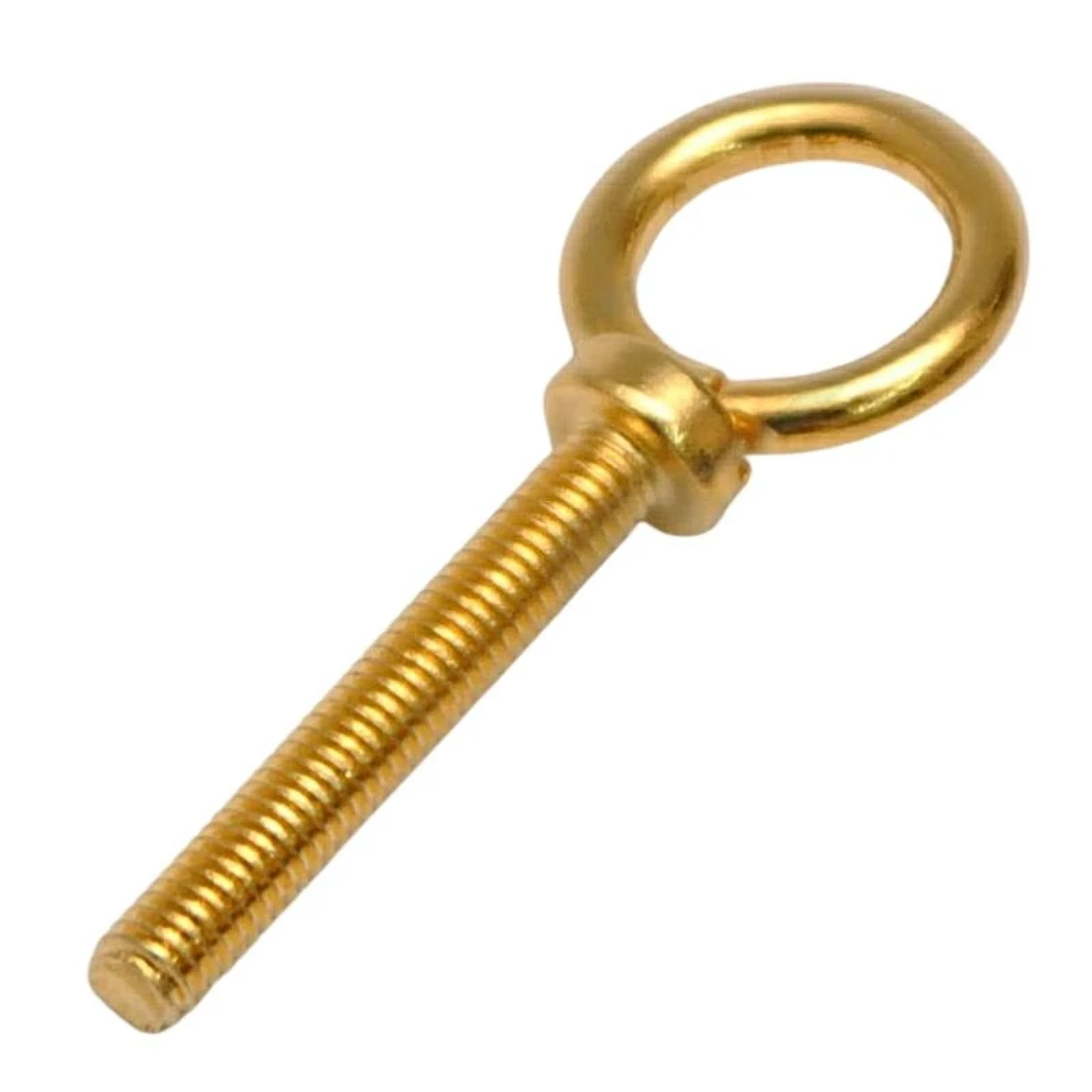
A threaded attachment with ring: internal clearance and assembly sequence should be checked on a complete sample.
For a threaded solution, the hidden side of the panel is as important as the visible side. Internal clearance, reinforcements, lining finish and the order of assembly should all be checked before the bag is closed. A component fitted after lining may involve different steps from an attachment installed before the final panels are assembled.
Materials and finishes: consistency does not mean identical parts
Zamak, brass, iron, plastic and other materials can create very different effects on the same bag. The decision is not only about colour. Presence, geometry, surface treatment and the relationship with zippers, closures, chains and feet also change. The most reliable approach is to compare a small set of real components on the chosen leather.
Consistency does not always mean complete uniformity. A design can intentionally use different surfaces, for example a more textured finish on the strap and a cleaner one on the closure. What should be avoided is an accidental mix of tones or treatments that look similar in a catalogue but very different once assembled.
Measurements: strap width is only the starting point
Internal width is essential, but it is not the only check. A strap can change section along its path: it may become thicker at a seam, fold around a reinforcement or include turned edges. The direction in which it enters a ring or slider also changes the result, especially with firm leather or layered straps.
Prepare a sample with the same materials and thicknesses as the final item. It should include the strap section, selected hardware and attachment point. If adjustment is required, move the strap in both directions and check that the keeper retains the free end without compressing it.
Check the reverse side and internal bulk
When an attachment has a counterpart, screw or threaded section, the hidden part deserves the same attention as the visible side. It may fall on a seam, reinforcement, pocket or area covered by lining. Mapping those relationships on the pattern in advance helps avoid late corrections and keeps the assembly sequence clear.
A complete system for an adjustable, removable shoulder strap
An adjustable removable strap is a useful way to see how the families work together. The bag body receives an attachment or leather tab with a ring; the snap hook enables removal; the slider supports adjustment; the keeper retains the loose end; a buckle is used only if the design calls for that type of adjustment or fastening.
This is not a compulsory shopping list. A fixed strap may not use snap hooks, a handbag may only need rings and attachments, and a buckled strap may not need a slider. The value of the method lies in recognising which function is actually required instead of reproducing a combination used on a different design.
Common hardware-matching mistakes
- Choosing by outside dimensions: the useful datum is the internal space for the finished strap and its true thickness.
- Using a buckle as a keeper: the two parts have different functions and may require different constructions.
- Ignoring assembly order: an attachment may need to be positioned before lining, final seams or panel closure.
- Mixing finishes without a sample: metal parts that appear similar can have very different tones and reflections.
- Assuming compatibility: similar shape, size or material does not prove that a snap hook, ring and attachment will work correctly together.
- Forgetting movement space: a moving component needs room to open, turn or slide without marking the leather.
Frequently asked questions
What is the difference between a ring and a slider?
A ring is commonly used as a connection or transition point. A slider guides a strap and may support adjustment. The final role depends on the construction of the bag and the component geometry.
How do I choose the size of a shoulder-strap ring?
Start with the finished strap cross-section, including edges, stitching and thickness at the pass-through point. Then test that it enters, moves and remains guided as intended.
Should a keeper be the same size as the buckle?
It should be consistent with the strap and its task, but there is no automatic equivalence. A sample with the finished strap shows whether it retains the loose end without binding.
When is a snap hook useful?
When a design needs a detachable shoulder strap or removable accessory. Check it together with the ring or attachment on which it will be engaged.
Can I mix hardware finishes?
Yes, when contrast is intentional. Compare real samples together, because colour and surface treatment can look very different from their appearance on screen.
Is a zamak ring suitable for every bag?
No. Shape, dimensions, finish, attachment point and strap construction must be assessed for the individual model.
Should I choose the attachment or the snap hook first?
Assess the entire system: bag body, attachment or tab, ring and snap hook. The connection must leave room for the mechanism and for the leatherworking sequence.
Is a D-shape only an aesthetic choice?
No. Alongside its visual character, its straight side can be useful next to a tab or bag body. The correct choice still depends on the strap path and attachment point.
How can I see whether hardware interferes with lining?
Map or test the inner side of the panel as well. Consider counterparts, threaded sections, screws, seams and reinforcements before the item is lined or closed.
Can the same hardware be used for a handle and a shoulder strap?
Only when function, dimensions and construction are genuinely compatible. A fixed handle and a removable shoulder strap may need very different connection points.