


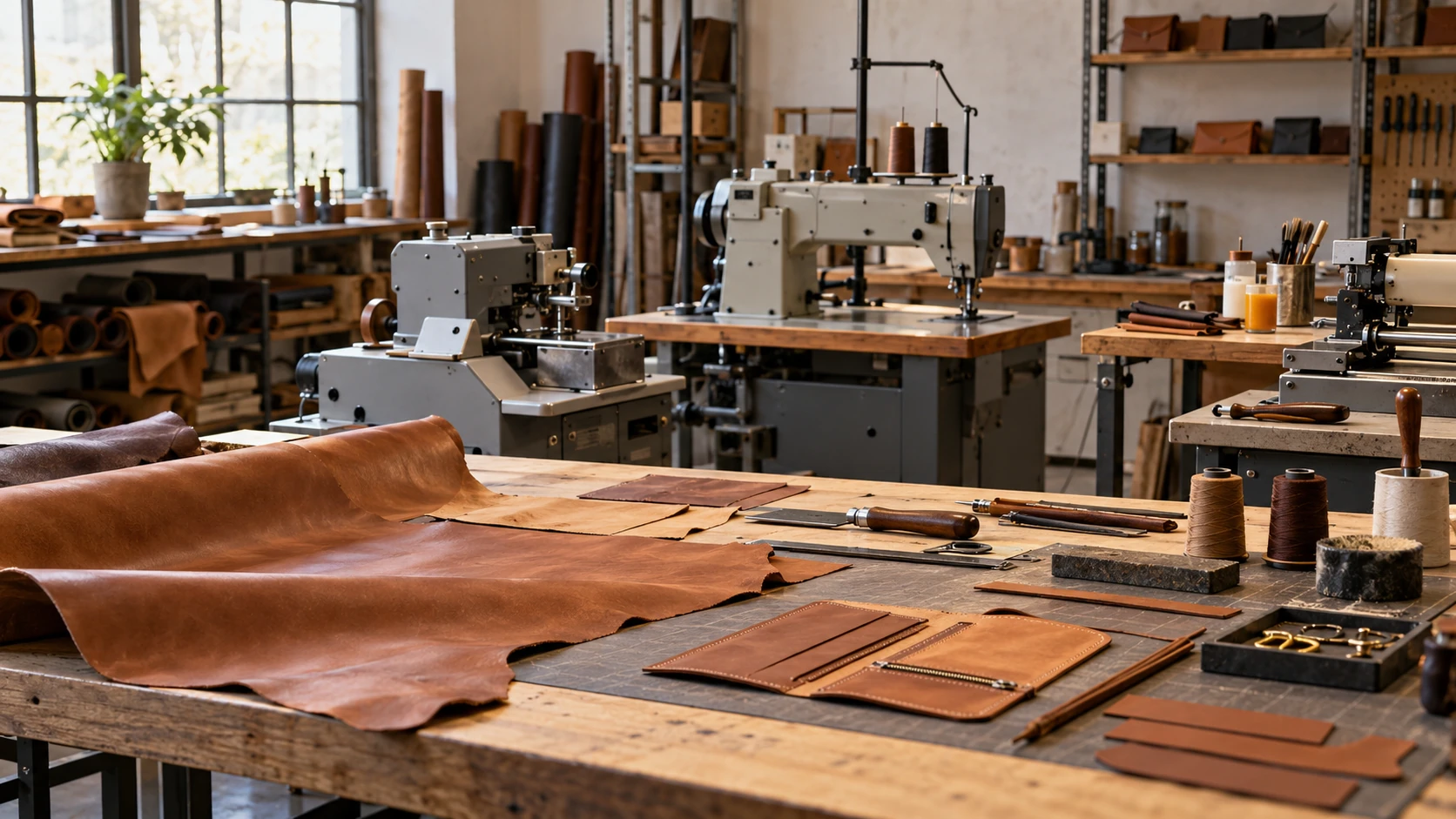
Leather Goods Machinery: Which Machines Are Needed at Each Production Stage?
In a leather goods workshop, choosing a machine should not begin with the catalogue. It should begin with the point in the process that needs to become more controlled. Cutting leather, reducing thickness, joining components, bonding, trimming and finishing an edge are different operations: the material, expected result, production order and sample checks all change.
The leather goods machinery category brings together families that can help explore these needs. This guide serves a different purpose: it maps the process, helping you identify the stage to examine, the questions to ask and the point at which a category or technical specialist should be involved, without treating different machines as interchangeable solutions.
Before choosing a machine: read the production cycle
A bag, belt, accessory or footwear component does not always go through the same stages, nor does it always follow the same order. The useful question is therefore not only “which machine do I need?”, but which result do I need before the next stage begins?
A cycle can include material preparation and cutting, thinning selected areas, joining through stitching or bonding, trimming, turning in, hardware application and edge finishing. Some activities remain manual by choice, because of the quantity involved or because of the article shape; others can call for dedicated equipment when the complexity of the piece or workshop organisation makes it appropriate.
Before comparing a machine, collect practical information: material type and thickness, piece shape and dimensions, actual production sequence, quantities to handle, available space, operator competence and the checks required on the result. Volume alone is not a sufficient criterion: even a small series may need accuracy and continuity, while a larger production can involve several separate stages.
Cutting and material preparation
Cutting is the starting point for the component. Depending on the project, it may involve manual tools, blade-based solutions, equipment for repeated cuts or systems that support a more structured operation. What matters at this stage is consistency between material, pattern, working allowance and the following step: an irregular edge or uncontrolled size can make assembly, stitching or finishing more difficult.
There is no single “cutting machine” suited to every workshop. The selection should consider whether the work involves flat pieces or complex shapes, samples or series, soft leathers or laminated materials, as well as the cutting system already in use. Where the need is to repeat a shape or use dedicated tools, assess the compatibility of the complete setup rather than the machine body alone.
The stage to verify
Before proceeding, observe how the piece must reach the following stage: does it simply need to be separated from the material, prepared for stitching, thinned along an edge or made ready for an application? This question prevents choosing a solution by the name of the machine rather than by its function in the cycle.
Skiving and thickness reduction
Skiving is relevant where it is necessary to reduce or modulate thickness in specific areas, for example along an edge that will be folded, stitched or overlapped. It is not the same as simple cutting: the material remains in place but is prepared to make assembly more suitable for the intended construction.
Assessing a skiving machine requires care. Leather type, structure, starting and desired final thickness, width of the area involved, edge path and sample test all affect the result. The skiving machines category is the starting point for this family, while operating parameters must be defined for the real material and process.
It is useful to distinguish two needs that are often confused: thinning an edge for a fold and correcting a variation in material thickness. They can require different checks. A well-documented test, including sample, edge and production sequence, is more useful than a choice based only on the machine designation.
Stitching and assembly of the item
In stitching, a machine becomes part of the cycle where the construction requires a thread-based join. However, the “sewing machine” category contains very different needs: stitching flat elements, working across thickness changes, sewing close to edges, handling small components or pieces that are already partly assembled. The shape of the article and the stitch path matter as much as the material.
The sewing machine category makes it possible to examine the solutions available in the catalogue. To assess them correctly, prepare a representative sample: not simply a rectangle of leather, but the same overlaps, curves and passages that the machine will encounter on the finished item.
Stitching should not be selected separately from assembly. Consider when adhesive is applied, whether the edge has already been turned in, which hardware is already present and whether the piece needs working clearance. In this way, the machine is assessed as part of the flow rather than as an independent addition.
Bonding: the system follows the material and working method
Bonding is a distinct stage from choosing the adhesive. A formulation can be assessed according to the materials and cycle stated in its documentation; the application system, on the other hand, concerns how adhesive is distributed in daily work. A bench, container, gun, roller or integrated solution each serve different gestures and working organisations.
For those assessing equipment, the gluing machines category brings together systems intended for application. The choice requires clarity on the bonding area, component shape, continuity of the operation, intended feed method and integration with the stages before and after. It is not appropriate to infer settings, performance or compatibility from a general guide: follow the current information for the adhesive and the actual system selected.
This distinction also helps prevent misaligned purchases. A workshop may need to improve application repeatability without changing the formulation; in other cases, the first priority is to verify adhesive behaviour on the material. The decisions are connected, but they are not the same.
Trimming, turning in and edge control
After more components have been joined, the item may need work on its edges: removing excess material, making a profile more regular, preparing a fold or supporting the construction of an edge. These operations directly affect the final appearance and preparation for finishing.
Trimming machines are a family to consider where the need is to control the edge after assembly. They should not be confused with initial cutting or aesthetic finishing: each stage addresses the piece in a different condition. Before assessing a solution, observe whether the edge arrives already bonded, stitched, turned in or still awaiting preparation.
Where the project includes a fold, preparation does not depend on equipment alone. Material, thickness, edge radius, operation order and the quality required on the finished sample all contribute. It is therefore useful to describe the full sequence to the person evaluating the machinery rather than only naming one step.
Edge finishing: when the stage becomes part of the machine cycle
Edge finishing can remain a bench operation or require a differently organised solution, depending on the article type and adopted cycle. Edge preparation, finishing material, application, drying and inspection can influence one another. A machine does not replace judgement on the sample: it needs to be introduced into a process that is already understood.
To explore dedicated solutions, the edge dyeing machines category is relevant to the machine stage. The guide to leather edge finishing remains the process-level resource for primer, edge paint and application; here, the focus is on recognising when a workshop needs to assess equipment and which information to bring to the test.
The questions are straightforward but decisive: is the edge straight or curved? What is the component geometry? How many passes make up the cycle? How is the result checked between stages? The most suitable system is the one compatible with the real cycle, not the one that appears most complete on its own.
Presses and hardware-application operations
Presses and small presses are relevant to operations that apply or work components with compatible tools, punches, dies or equipment. Their role is not to replace every machine in the workshop, but to enable a specific stage with the appropriate setup.
The presses for leather goods category is the commercial reference for this family. Compatibility between the accessory, tool, die and machine must be verified case by case: do not assume a combination merely from the similarity of two products or a dimension shown in a product page.
A dedicated guide to presses, punches and dies can examine this subject in more detail later. In a machinery map, it is enough to place the press in the right phase and remember that selection depends on the component to be worked and the compatible system.
Manual, semi-automatic or automatic: the criterion is not status
The comparison between manual work and machinery should not become a ranking. A manual operation can be appropriate where control over a detail is needed, flexibility between different articles is important or the stage is still being tested. A more structured solution may become relevant where the task needs to be organised consistently with the rest of the department.
To choose clearly, begin with five variables: required repeatability, piece complexity, flow continuity, available space and necessary competence. Add material type and the ability to test a real operation. The result of a demonstration or sample test should not automatically be extended to every leather, shape or configuration.
A useful checklist before selecting machinery
Arriving at an assessment with organised information reduces uncertainty. You do not need to know the exact model already; describing the production problem correctly is more useful.
- Cycle stage: cutting, preparation, skiving, assembly, bonding, trimming, application or finishing.
- Material and construction: leather or material type, thicknesses, number of layers, edges, curves and components already present.
- Real sample: a representative piece with the same difficulties as the finished product.
- Result to control: edge accuracy, stitch regularity, adhesive distribution, edge preparation or component application.
- Workshop organisation: workstation sequence, space, supplies and people involved in the stage.
- Information to verify: machine documentation, accessory compatibility, operating conditions and assistance available for the specific case.
This information does not replace a technical assessment, but makes the request more precise. It also helps prevent a choice driven only by a category name or one isolated part of the process.
How to use the catalogue without confusing the stages
The catalogue is more useful when consulted by functional family. If the need is to thin an edge, begin with skiving machines; if it is adhesive distribution, begin with gluing machines; if it is edge preparation after assembly, begin with trimming machines; if it is application with dies or punches, begin with presses.
This method avoids two common mistakes: selecting a machine because its name contains a familiar word, or treating machinery designed for different stages as equivalent. The right category is a first filter, not confirmation of suitability. A decision still needs a sample, the production sequence and the necessary compatibility checks.
Frequently asked questions about leather goods machinery
Which machines are essential when starting leather goods production?
It depends on the type of article and the stages you intend to carry out in-house. Mapping cutting, preparation, assembly and finishing for your own product is more useful than looking for one list valid for every workshop.
Is a skiving machine needed for every leather?
No. The need depends on the construction of the item, the edge to prepare and the thickness to manage. Assess the material and a real sample before defining a solution.
Can I select a sewing machine by looking only at leather thickness?
No. In addition to thickness, consider overlaps, piece shape, stitch path, margins and the clearance required by the construction.
What is the difference between an adhesive and a gluing machine?
An adhesive is selected for materials and the cycle stated in its documentation; a gluing machine is the system that helps distribute it during the operation. They are connected but distinct decisions.
When does a trimming machine become useful?
When the process needs to regularise or prepare edges after assembly. The assessment depends on the point in the cycle where the component arrives and the result required on the edge.
Do automatic edge dyeing machines always replace manual application?
No. The choice depends on the article, edge geometry, production sequence, tests and workshop organisation. There is no automatic replacement that is valid in every context.
Is a press suitable for every accessory?
No. Verify compatibility between press, tool, die and the component to be worked. Do not presume compatibility from images or similar names.
Should I choose the machine first or define the process?
It is preferable to define the process and the result to control first. The machine can then be assessed as the response to a concrete stage, not as a generic starting point.
What information should I bring when assessing machinery?
A representative sample, materials and thicknesses, a description of the sequence, desired result, indicative quantities, available space and accessories already used are useful details for a more relevant assessment.
Can used machinery be considered through this guide?
The used market requires separate checks on condition, configuration, availability, documentation and compatibility. It should therefore be addressed through a dedicated path, rather than being automatically equated with new machinery.